
There are things that time takes from us, and then there are things we allow time to take. Some disappear through the natural passage of generations, while others are lost because the world never afforded them the space to exist. Stories untold, names forgotten. Relationships are reduced to fragments, and entire parts of someone's identity become something they carry in silence.
There’s a particular kind of emptiness in that sticks with me while recognizing this. It’s not necessarily the grief of losing someone you once knew, but the grief of realizing how many people lived entire lives without ever being afforded the opportunity to be fully and truly known.
I left La Bola Negra (2026) carrying that feeling.
What stayed with me was not the sadness of the stories being told, but the realization of how many stories like them might never be told at all. How many people lived, loved, formed relationships, and imagined futures that the world around them did not allow them to acknowledge? And how much of someone's existence can disappear when the people who knew them are no longer here to tell their story?
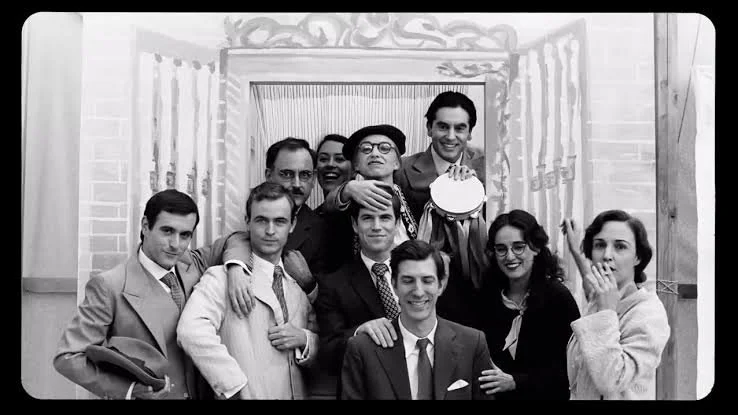
I found myself thinking less about history as something written in books and more about the lives that occupy the lines between the dates, the events, and the historical accounts. The people who were not necessarily remembered as historical figures, but who were, nevertheless, figures living through history. Perhaps that is what makes the film's triptych of stories so riveting. They remind us that the passage of time does not happen in isolation. Lives overlap, histories intersect, and the traumas of one generation often find their way into another. Life is non-linear.
A still from La Bola Negra (2026)
The Lives Behind History
One of the moments that stayed with me most was the revelation that Sebastián was Alberto's grandfather. Alberto living in 2017 getting a first-glimpse at his maternal grandfather, Sebastián living in 1937, was such a fun revelation as an audience member following this triptych.
Alberto's discovery of his grandfather's identity through time and research changed the way he understood Sebastián. Suddenly, there was something more to the person he had known through family history. A part of Sebastián's life that had remained hidden began to take shape. But Sebastián's life didn’t become meaningful only when Alberto discovered it. His experiences, his relationships, and the person he was had always existed, whether or not the people who came after him knew about them.
The connection between Sebastián and Alberto made me think about how much of the past remains just outside our understanding. We may know the names of our relatives, recognize their faces in photographs, and remember the stories that have been shared with us. But there are entire dimensions of their lives that we may never know about. Not because those dimensions did not exist, but because they were never given the opportunity to become part of the story.
And sometimes, it takes an unexpected discovery to remind us that the people we think we know have lived lives far more complicated, intimate, and human than the versions of them that have been passed down.
The Intimacy of the Unspoken
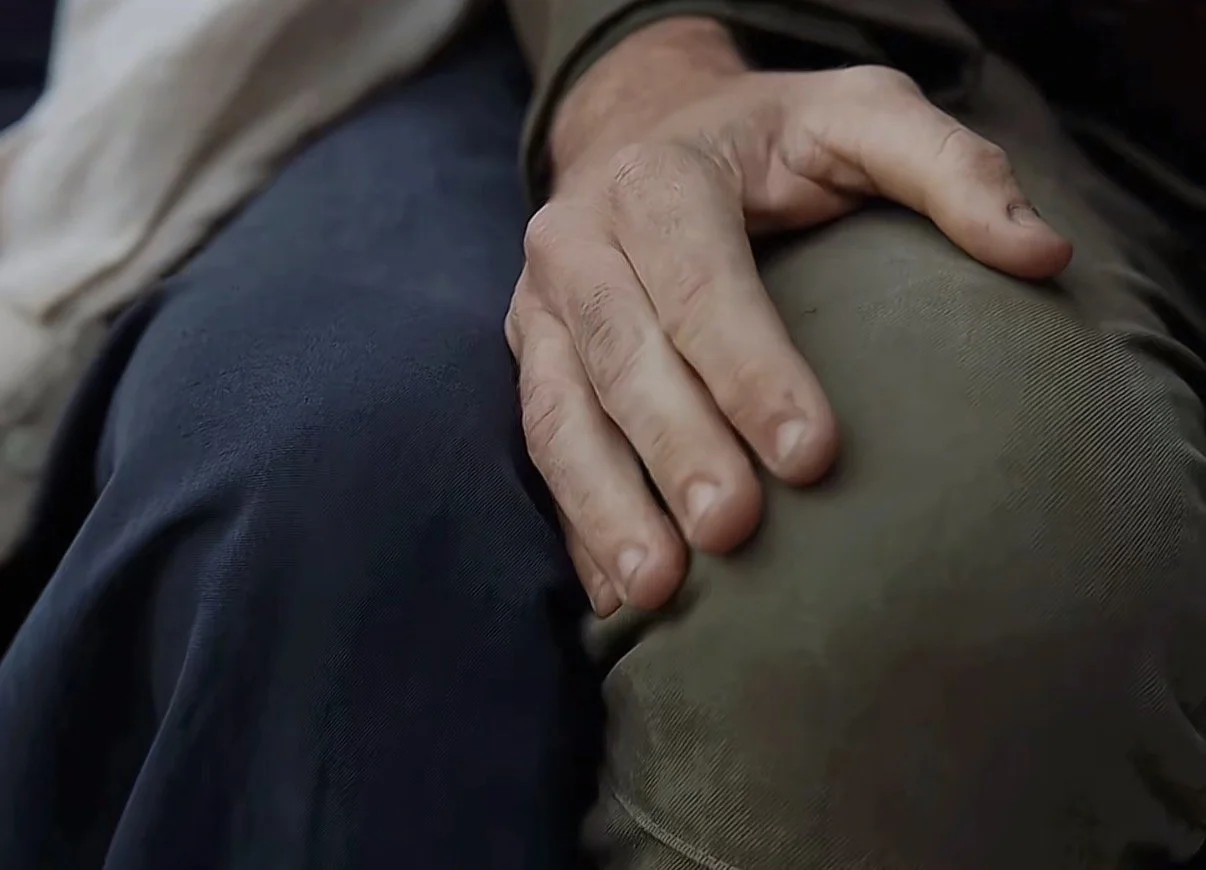
There’s another moment in the film that remained with me: the image of Sebastián, conscripted into the right-wing Nationalist army, and Rafael Rodríguez Rapún, a Republican prisoner of war, allowing their knees to touch shortly before Rafael’s execution. It’s such a small gesture. There is no grand declaration of love, no elaborate expression of affection. Just the quiet yearning of two individuals, each on opposing sides of conflict.
A still from La Bola Negra (2026)
In a moment defined by the possibility of losing everything, there’s still a desire for closeness. Even when the circumstances surrounding these individuals are shaped by fear and violence, there remains something profoundly ordinary about their need to be near one another.
Perhaps that’s what makes the moment so difficult to forget. It reminds us that the people we encounter through historical accounts were not simply representatives of a particular struggle. They were people with relationships, attachments, fears, and desires. They wanted the same small things that make a life feel like a life: to be close to someone, to be understood, to experience affection without having to question whether it was permitted.
It’s easy to speak about historical oppression in broad terms. We can describe laws, institutions, social attitudes, and the injustices that shaped entire generations. But sometimes, a small expression of affection makes the human consequences of those histories feel more immediate than any explanation could.
The touching of two knees is not, in itself, a grand historical event. Yet it carries the weight of everything surrounding it. It’s a reminder that even in the most inhumane circumstances, people do not stop being human. And perhaps that is what I find most heartbreaking: how ordinary the desire to love and be loved really is, and how extraordinary the world can make it seem.
The History Behind Silence
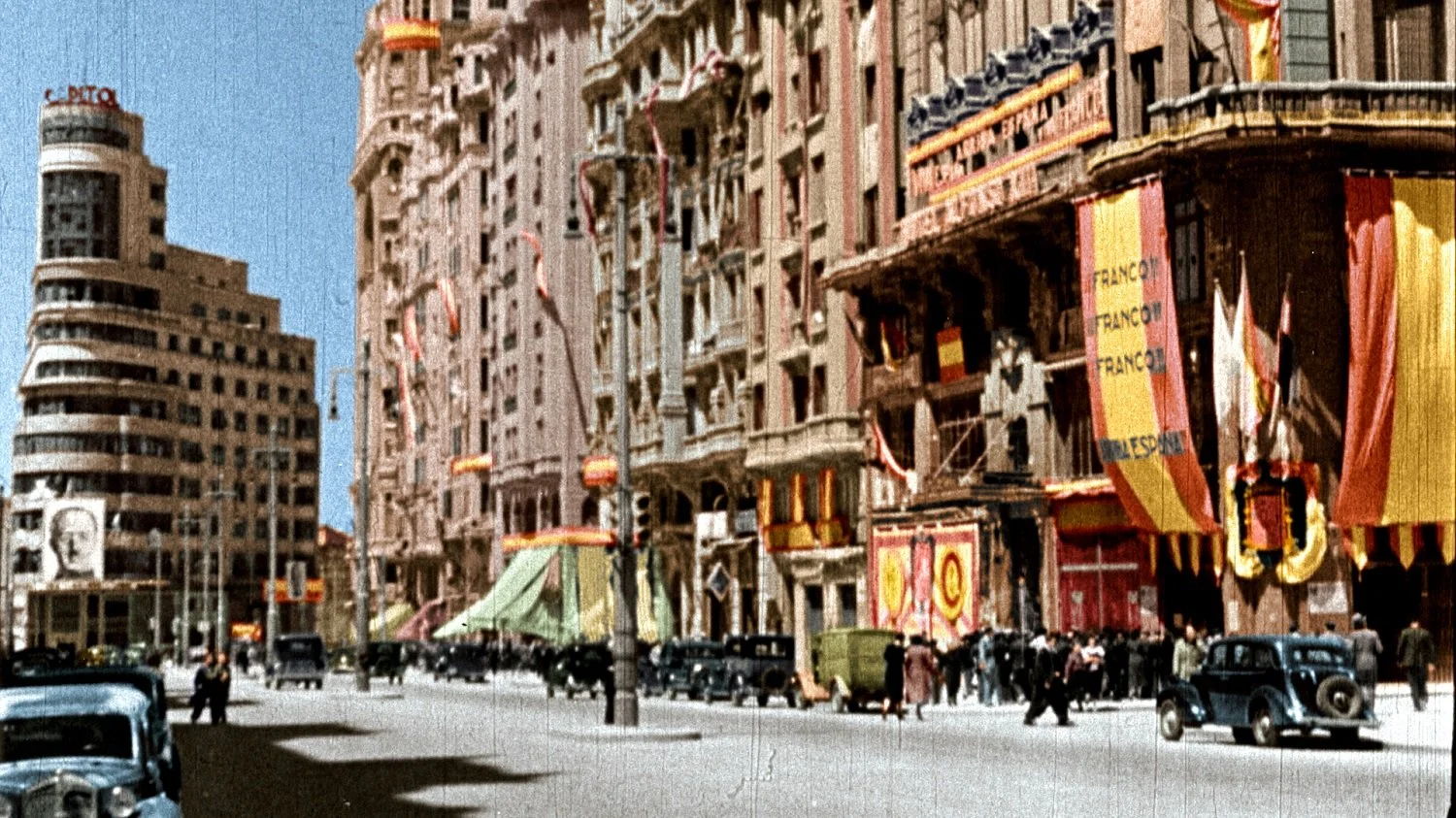
To understand the weight of these stories, I think it is important to consider the history surrounding them. In Spain, the experiences of queer people during the Franco dictatorship were shaped by a political and social climate that sought to enforce a particular understanding of morality, family, and acceptable behavior.
Throughout Francisco Franco's dictatorship (1939-1975), the repression of homosexuality took different forms throughout the regime. In 1954, the Francoist government amended Ley de Vagos y Maleantes, or Law of Vagrants and Beggars, to explicitly include homosexual people among those considered dangerous. This wasn’t simply a matter of social disapproval, rather it gave the state a legal mechanism through which people could be detained and subjected to measures intended to control and punish them. In 1970, the regime replaced that legislation with Ley de Peligrosidad y Rehabilitación Social, or Law of Social Danger and Rehabilitation. Despite the language of rehabilitation, the law continued to classify homosexual acts as evidence of social dangerousness. It provided for measures including confinement in reeducation institutions and restrictions on where individuals could live or go. The language of rehabilitation concealed something much more troubling: the assumption that these people were somehow in need of correction.
A colored photo of Francoist Spain
The consequences extended beyond the written laws themselves. The threat of police intervention, public exposure, imprisonment, and social rejection shaped the conditions under which people could form relationships and express themselves. For many, discretion was not simply a personal preference. It was a means of protecting themselves and the people they loved.
Even after Franco's death, these statutes were not immediately erased. The legal classification of homosexual acts was removed in the transition to democracy, with the relevant provisions repealed at the end of 1978 and taking effect in early 1979. The broader effects of decades of repression, however, could not be undone by a change in legislation.
I find myself thinking about the lives that existed within this history. The people who may have spent years carefully separating the person they were from the person they were permitted to present to the world. The families who may never have known certain parts of someone's life. And the generations who inherited those silences without necessarily knowing where they began. It’s difficult to look at these histories and think of them as distant. The laws may belong to another period, but the people who lived under them were not fundamentally different from the people living around us today. They were navigating the same desire for connection, belonging, and recognition. Their lives were happening in the same world, even when the world refused to make room for them. And I think this is where the film's personal stories become inseparable from its historical context.
The Past is Not Separate From Us
As someone who didn’t live through the experiences represented in the film and who is also not a part of the queer community, I don’t want to pretend that I can fully understand what it meant to live through them. I can recognize the injustice, feel the weight of what was lost, and try to understand the histories that made those experiences possible. But there’s a difference between witnessing a story and having lived it.
What I can do, however, is listen. I can learn about the histories that were overlooked, seek out the stories that were not preserved in the ways they should have been, and recognize that the freedoms and understandings we have today didn’t emerge independently of the people who came before us.
The film made me want to learn more about queer history in Spain. I found myself thinking about how the social and political circumstances of a particular time can shape not only what people are allowed to do, but what they are allowed to remember and what they are allowed to say about themselves. It also made me consider how easily we separate the past from the present. The past is not a distant place inhabited by strangers. It is made up of people whose lives eventually became part of the world we inherited.
And that realization changes the way I think about remembrance. Remembering is not simply an exercise in looking backward. It is also a way of understanding the present more honestly. It asks us to consider whose experiences have shaped the world around us, whose contributions have gone unrecognized, and whose stories are still waiting to be heard.
They Were Here Too
I think what I’m left with most after La Bola Negra (2026) is a desire to remember.
Not simply to remember the suffering these individuals endured, or to recognize them only through the circumstances that made their lives difficult. They deserve to be remembered as more than what unfortunate circumstances shaped them to be. They were people before they became part of a historical narrative. They had personalities, relationships, hopes, dreams, and entire worlds that existed beyond the moments through which history might choose to define them.
There is a danger in remembering people only through their suffering. Although acknowledging that suffering is necessary, it can also become another way of reducing someone to a single dimension of their existence. Their lives become examples of injustice rather than lives in their own right.
History is not only filled with war and peril, but also with love and happiness. It’s important we remember the latter fragments of history. I want to remember the people who loved quietly, who found companionship where they could, who made lives for themselves despite the limitations placed upon them. These are not people of tall tales or legends. They are not distant figures whose lives exist only in the pages of history. They are real, tangible stories originating from mortals like you and me. Their lives were happening alongside the lives of everyone else, even when the world around them refused to acknowledge them.
And perhaps that is the most important thing the film reminded me of: these people were never separate from us. The passage of time may distance us from the people who came before us, but it does not diminish the significance of their lives. Their experiences helped shape the world we inhabit, and their absence from the stories we tell does not mean they were never part of it.
There’s no way to recover every story that was lost. There are people whose names we will never know, relationships we will never be able to understand, and lives that will remain only partially visible to those who come after them. That absence is difficult to sit with. But perhaps remembering begins with acknowledging it. With recognizing that something existed, even when we cannot recover all of its details.
Because before they were history, they were people.
They were here. They lived. They loved. They mattered.
And they deserve to be remembered.
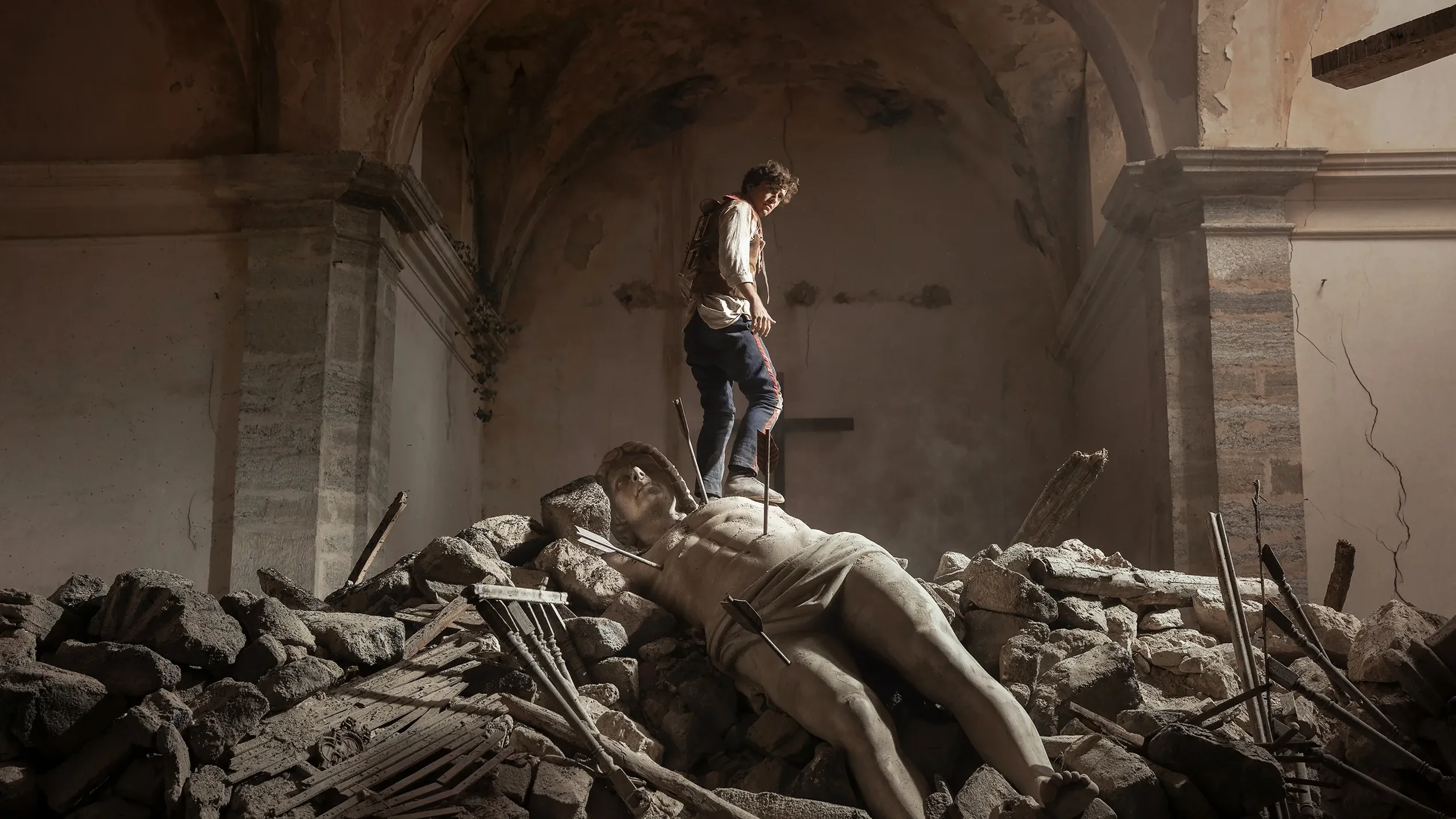
“Este país tiene demasiadas historias de amor enterradas en los campos. Hay que arañar la tierra para que salgan....para que existir más.
(This country has too many love stories buried in the fields. You have to scratch at the Earth to bring them out...therefore, more can exist.)”
A still of Sebastián atop a fallen San Sebastián statue in La Bola Negra (2026).
.....
.....
Works Cited
Ambrossi, Javier, and Javier Calvo, directors. La bola negra. Suma Content Films, 2025.
Gahete Muñoz, Soraya. “Ser homosexual durante el franquismo. Su rastro en los expedientes del Juzgado Especial de Madrid para la aplicación de la Ley de Vagos y Maleantes (1954–1956).” Cuadernos de Historia Contemporánea, vol. 43, 2021, pp. 185–200. https://doi.org/10.5209/chco.78177.
Ministerio de Igualdad. “Activismo en la clandestinidad y los primeros frentes de liberación homosexual (1970–1979).” Gobierno de España, https://www.igualdad.gob.es/ministerio/dglgtbi/matrimonio-igualitario/liberacion-homosexual/. Accessed 11 Nov. 2026.
Mora Gaspar, Víctor. “Rastros biopolíticos del franquismo: la homosexualidad como ‘peligrosidad social’ según las sesiones de la Comisión de Justicia española en 1970.” Revista Historia Autónoma, no. 14, 2019, pp. 173–193.
Spain. Ley 16/1970, de 4 de agosto, sobre peligrosidad y rehabilitación social. Boletín Oficial del Estado, 6 Aug. 1970, https://www.boe.es/buscar/doc.php?id=BOE-A-1970-854.
Spain. Ley 77/1978, de 26 de diciembre, de modificación de la Ley de Peligrosidad y Rehabilitación Social y de su Reglamento. Boletín Oficial del Estado, 11 Jan. 1979, https://www.boe.es/eli/es/l/1978/12/26/77.
